

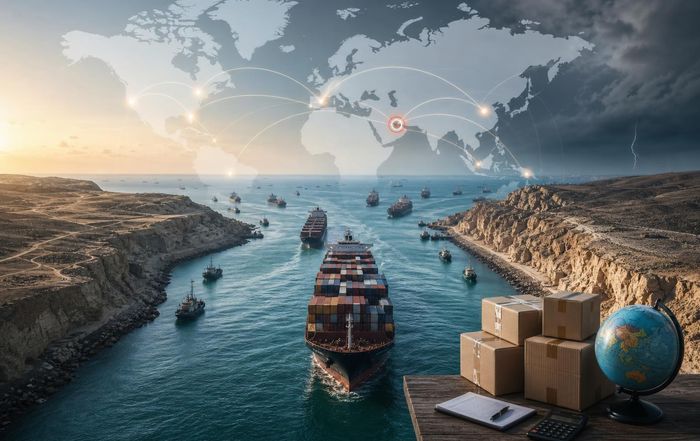
How Global Shipping Chokepoints Really Affect Small Importers
When a ship gets stuck in a canal or missiles threaten a key sea lane, headlines tend to focus on oil prices and big multinationals. Yet some of the most exposed players in these moments are small and mid-sized importers whose margins, cash flow, and customer relationships can be upended by a single disruption. Understanding how global shipping chokepoints work-and how risk cascades through freight markets-is increasingly essential for founders, e-commerce sellers, and growing businesses that rely on international supply chains.
What Counts as a Global Shipping Chokepoint?
Maritime "chokepoints" are narrow passages or constrained routes where a large share of world trade must pass. If traffic is blocked or threatened, there are few or no easy alternatives, so disruption quickly ripples through global logistics, commodity markets, and manufacturing. The International Energy Agency and U.S. Energy Information Administration regularly highlight several critical chokepoints for oil and gas, but they are equally important for containerized goods, raw materials, and components.
Key examples include the Suez Canal, Panama Canal, Strait of Hormuz, Bab el-Mandeb, Bosporus, Strait of Malacca, and Strait of Gibraltar. Recent years have underlined their vulnerability: the 2021 Ever Given grounding in the Suez Canal, drought-driven capacity cuts in the Panama Canal, and repeated attacks on merchant vessels in the Red Sea have all forced shipping lines to reroute or delay services. According to the United Nations Conference on Trade and Development (UNCTAD), over 80% of global merchandise trade by volume moves by sea, so any serious constraint at these points can rapidly affect freight capacity and cost.
For small importers, the technical geography matters less than the mechanisms: chokepoints concentrate risk. When a single incident can simultaneously reduce available capacity, increase sailing distances, raise fuel costs, and trigger war-risk premiums, the result is a sudden, often brutal repricing of logistics that small firms are least equipped to absorb.
How Disruptions Translate into Costs for Small Importers
Most small importers buy freight space indirectly through freight forwarders, online logistics platforms, or consolidators rather than contracting directly with major carriers. This leaves them exposed to spot-market volatility when disruptions hit. When the Suez Canal was blocked in 2021, container spot rates on some Asia-Europe routes quickly multiplied several-fold; during the Red Sea crisis and extended Cape of Good Hope reroutings, similar spikes appeared. Data compiled by indices such as the Drewry World Container Index and Freightos Baltic Index (both widely covered by outlets like Reuters and The Financial Times) show how quickly rates can move when a chokepoint is compromised.
For a small importer moving only a few containers per year, this can turn a previously profitable product line into a loss-making one overnight. A shipment budgeted at $2,000 per forty-foot equivalent unit (FEU) that suddenly costs $5,000 or more erodes margin that may only have been a few percentage points to begin with. Unlike large retailers that can average costs across thousands of containers or renegotiate with suppliers, smaller firms often have to choose between accepting reduced or negative margins, raising prices and risking demand, or cancelling orders and disappointing customers.
Beyond pure freight rates, there are secondary cost effects. Longer routes mean higher bunker fuel consumption, prompting carriers to add emergency surcharges. War-risk insurance premiums can rise rapidly when vessels must traverse conflict-adjacent waters, and those costs are usually passed down the chain. Port congestion stemming from redirected traffic can add demurrage and detention fees if containers cannot be cleared quickly. For importers relying on tight cash-conversion cycles, these additional and sometimes unpredictable charges can strain working capital and complicate financing arrangements with banks or trade-finance providers, an issue that intersects directly with broader banking and economy concerns.
Lead Times, Reliability, and Inventory Risk
Even when goods eventually arrive, chokepoint disruptions can seriously damage schedule reliability. When carriers divert around Africa instead of using the Suez Canal, transit times between Asia and Europe can lengthen by 10-20 days or more. The International Chamber of Shipping and UNCTAD have both highlighted the compounding effect: once schedules are knocked out of sync, it can take months for liner networks to normalize, even after the initial cause is resolved.
For small importers, this uncertainty is often more damaging than the headline delay. Many young businesses have shifted toward lean inventory models and just-in-time replenishment to reduce warehousing costs and free up cash. When transit times become unpredictable, they face a difficult choice: carry more inventory to buffer against delays, tying up capital and increasing storage costs, or accept a higher risk of stock-outs and lost sales. For e-commerce brands, a few weeks of "out of stock" on key SKUs can push customers to competitors, damage platform rankings, and increase customer-acquisition costs later. In B2B supply chains, late deliveries can breach service-level agreements and weaken relationships with downstream buyers.
There is also a planning challenge. Production lead times at factories, booking windows with freight forwarders, and customs clearance at destination ports all rely on reasonably predictable shipping schedules. When chokepoint disruptions cascade into blank sailings, last-minute port omissions, or rolled bookings, smaller importers may find that their carefully planned shipment misses a key retail season or trade show. Unlike large importers that may have multiple sailings each week, a small business might only bring in a few shipments per year, so missing a single window can have outsized consequences for annual revenue.
Pricing Power and Competitive Disadvantage
Large multinational importers typically negotiate long-term contracts with shipping lines, hedging some of the volatility in freight rates. They may also have diversified sourcing across regions, multiple distribution centers, and the ability to pass cost increases through to customers more easily. Small importers, by contrast, often operate at the intersection of limited bargaining power and highly price-sensitive end markets.
When a chokepoint crisis pushes up freight rates, big retailers can sometimes absorb a portion of the increase, use their scale to secure capacity, or shift volumes between routes and suppliers. They may also negotiate priority space allocations. Smaller firms, buying space on the spot market or via less-influential forwarders, can find themselves priced out or pushed to the back of the queue. In extreme cases, importers report that they simply cannot secure a booking at any reasonable cost during peak disruption, while larger players continue to move cargo.
This asymmetry can accelerate market consolidation. Businesses with thin margins and limited reserves may be forced to pause imports, scale back product ranges, or exit certain categories entirely. Meanwhile, better-capitalized competitors that can weather the disruption may gain share and lock in relationships with suppliers and customers. Over time, recurrent chokepoint shocks can therefore reshape competition in sectors ranging from consumer goods to industrial components, a dynamic closely watched by institutions such as the World Bank and OECD, which regularly analyze trade resilience and supply-chain concentration.
Financial and Cash-Flow Strain
Shipping disruptions are not only an operational headache; they are a finance problem. When transit times extend and freight costs spike, small importers often need more working capital to fund the same level of trade. Goods are "on the water" longer, tying up cash in inventory that cannot yet be sold. At the same time, suppliers may still demand deposits or full payment before loading, while logistics providers require freight charges upfront or on short terms.
Banks and trade-finance providers, including export-credit agencies and development finance institutions, have highlighted this risk in their guidance to SMEs. Organizations such as the World Trade Organization and International Finance Corporation have noted that small firms already face tighter access to trade credit compared with larger corporates. When shocks hit global shipping, lenders may become more cautious, especially if collateral is in transit through higher-risk regions. For importers that rely on revolving credit lines or letters of credit, any tightening of terms or increase in interest costs can quickly erode profitability.
This is where broader business and investment strategy intersect with logistics. Firms that treat freight purely as an operational afterthought may overlook how deeply it influences their balance sheet, cash-flow forecasting, and banking relationships. Integrating supply-chain risk into financial planning-through scenario analysis, stress-testing, and proactive discussions with lenders-can make the difference between surviving a chokepoint disruption and facing a liquidity crunch.
Sector-Specific Vulnerabilities
Chokepoint disruptions do not hit all sectors equally. Importers of high-value, low-weight goods such as electronics, fashion accessories, or pharmaceuticals sometimes have the option to shift a portion of their volume to air freight during crises. While significantly more expensive per kilogram, air transport can preserve critical sales windows or maintain continuity for key customers. However, even air cargo capacity can be constrained when many shippers rush to switch modes, as seen during the pandemic, and the cost differential is often prohibitive for small importers except for their most profitable lines.
By contrast, importers of bulky, low-margin goods-furniture, basic household items, construction materials, or some food products-have far fewer alternatives. For them, ocean freight is effectively the only viable mode, and small changes in per-unit shipping cost can determine whether a product remains competitive. During extended chokepoint disruptions, some businesses may temporarily withdraw from certain markets or categories because they cannot raise prices enough to offset costs without losing demand.
There are also geographic nuances. Importers serving landlocked countries or relying heavily on a single gateway port can be more exposed to congestion and rerouting. Conversely, businesses in regions with multiple deep-water ports and robust rail or road connections may have more flexibility to redirect cargo. Trade policy and customs regimes also matter: some countries have streamlined procedures and digital systems that reduce clearance delays, while others add days or weeks of uncertainty on top of maritime disruptions. This policy dimension is a recurring theme in reports from bodies such as UNCTAD and the World Customs Organization, and it is increasingly relevant for founders considering where to base distribution hubs or how to structure cross-border operations.
Technology, Data, and the Role of AI
In the past, small importers often had limited visibility into where their containers actually were or how global events might affect upcoming sailings. Today, a growing ecosystem of digital freight forwarders, visibility platforms, and AI-driven analytics tools is changing that picture. Companies offering real-time vessel tracking, predictive estimated time of arrival (ETA) updates, and disruption alerts-drawing on data from sources like MarineTraffic, Lloyd's List, and satellite AIS feeds-make it easier for smaller firms to see problems earlier and adjust plans.
Artificial intelligence and machine learning are increasingly used to forecast congestion, recommend alternative routings, and estimate delay probabilities under different scenarios. While many advanced tools are marketed to large shippers, a number of platforms now target SMEs with subscription-based dashboards and integrations into e-commerce or inventory systems. This technological shift links directly to the broader technology and AI coverage that many business readers follow, as it illustrates how data-driven decision-making is moving from boardrooms of multinationals to small warehouse offices and founder laptops.
However, technology is not a panacea. Predictive tools can flag risks but cannot reopen a blocked canal or neutralize a geopolitical conflict. Small importers still need to translate information into practical actions: adjusting reorder points, communicating transparently with customers, and revisiting their mix of suppliers and ports. Moreover, digital tools themselves can introduce dependency risks if businesses rely too heavily on a single platform or fail to maintain internal knowledge of logistics basics.
Practical Risk-Mitigation Moves for Small Importers
While small businesses cannot remove the vulnerability of global chokepoints, they can reduce how exposed they are to any single disruption. Much of this comes down to strategy, contracts, and relationships rather than headline-grabbing technology.
Diversifying sourcing is one of the most powerful levers. Importers that rely entirely on a single country-route combination are more exposed than those that can shift part of their demand to alternative origins or regional suppliers when crises hit. Nearshoring or "friend-shoring" some production, even at a slightly higher unit cost, can provide valuable resilience. This trend has been widely analyzed by organizations such as McKinsey & Company and Boston Consulting Group, as well as multilateral institutions, which note that supply-chain resilience is increasingly a board-level concern rather than a purely operational one.
Contract structure also matters. Where possible, small importers can explore longer-term agreements with freight forwarders or non-vessel-operating common carriers (NVOCCs) that offer some rate stability and capacity commitments, even if they still rely on spot bookings for a portion of volume. Building strong relationships with logistics partners-rather than treating them purely as interchangeable vendors-can pay off when space is scarce and forwarders must decide whose cargo to prioritize.
Operationally, revisiting inventory policy is essential. This may mean holding slightly higher safety stock on critical items, staggering orders to avoid single large exposures, or using multiple ports of discharge where infrastructure allows. Integrated planning between purchasing, logistics, and sales teams can help ensure that marketing campaigns or product launches are not scheduled without confirming realistic arrival windows. These are the kinds of cross-functional decisions that sit at the intersection of marketing, operations, and finance in growing companies.
Finally, communication is a strategic asset. Small importers that are transparent with customers about potential delays, explain how they are managing disruptions, and offer alternatives or partial deliveries often preserve trust better than those that remain silent until goods are late. In B2B contexts, proactive updates can help downstream partners adjust their own planning, reducing the overall damage along the chain.
Policy, Sustainability, and the Longer-Term Outlook
Global attention to shipping chokepoints is not only about trade efficiency; it is increasingly tied to security and sustainability debates. Naval deployments in regions such as the Red Sea and Gulf of Aden, coordinated by alliances and organizations like NATO and the European Union, aim to protect merchant shipping from attacks and piracy. At the same time, environmental regulations-coordinated by the International Maritime Organization-are pushing the sector toward lower-emission fuels and more efficient vessels, with implications for route choices, speeds, and operating costs.
For small importers, these macro trends may feel remote, but they shape the baseline conditions under which freight markets operate. Investments in alternative routes, port infrastructure, and rail corridors-such as EU-backed initiatives or China's Belt and Road projects-can gradually reduce dependence on a few critical chokepoints, though they may also introduce new geopolitical complexities. Climate change adds another layer: droughts that reduce water levels in the Panama Canal or storms that disrupt key ports are likely to become more frequent, reinforcing the need for resilient supply-chain design. These environmental and resilience concerns align with broader sustainable business discussions that many entrepreneurs and investors now prioritize.
In the nearer term, volatility is likely to remain a defining feature of global shipping. Geopolitical tensions, regional conflicts, cyber-risks to port and vessel systems, and fluctuating demand from major economies all contribute to an environment where chokepoint disruptions can arise with little warning. Small importers cannot predict every shock, but they can treat shipping risk as a core strategic issue rather than a background cost-integrating logistics into decisions about product selection, pricing, financing, and growth.
For founders and managers building internationally connected businesses, the lesson is not to avoid global trade but to engage with it more deliberately. Those who understand how chokepoints shape freight markets, who build flexible networks and informed partnerships, and who use data to anticipate and communicate around disruptions will be better placed to compete, even when the world's narrowest sea lanes become the focus of the next crisis. For readers looking to connect these logistics realities with broader trends in world news, markets, and employment, shipping chokepoints are no longer a niche concern-they are a central fault line in the global economy that every growing business should understand.